
FAQ Answering Engine
- Handles repetitive resident questions with consistent responses.
- Routes users to service pages, forms, and department contacts.
- Supports conversational guidance for common workflows.
AI Assistant Platform
Government AI assistant software for resident questions, service routing, and workflow automation across websites, documents, and operational systems.
Private Walkthrough
CivIQ now reviews assistant workflows, safeguards, and rollout planning in guided private demos instead of a public chat-style preview.
Guardrails
Policy controls, escalation logic, and governance checkpoints.
Routing
Department handoff paths, service flows, and resident journeys.
Launch Plan
Readiness steps, analytics, and phased rollout guidance.
A city-ready Government AI Assistant with source-backed answers, service routing, and operational visibility across departments.
Deliver a Government AI Assistant with source-grounded answers, multilingual support, and resident-service routing from one unified interaction layer.
Private Rollout Preview
ProofPrivate Walkthrough
CivIQ now reviews assistant workflows, safeguards, and rollout planning in guided private demos instead of a public chat-style preview.
Guardrails
Policy controls, escalation logic, and governance checkpoints.
Routing
Department handoff paths, service flows, and resident journeys.
Launch Plan
Readiness steps, analytics, and phased rollout guidance.
6 Core Assistant Capabilities
Capabilities
Below the rollout overview is the detailed capability inventory teams use to evaluate knowledge quality, governance controls, resident UX, and operational readiness.
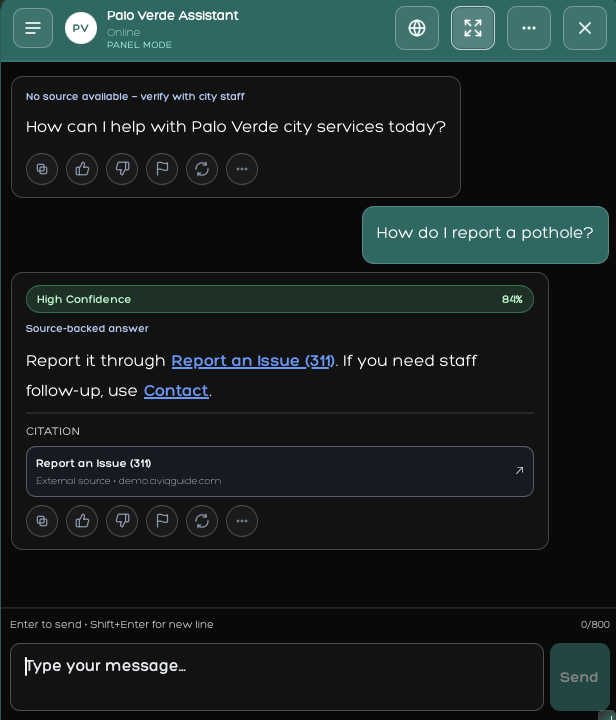
Assistant Capability Snapshot
Example interaction layout showing service-question handling, form guidance patterns, and citation-style response formatting.
Chatbot Features
Full capability inventory for assistant operations, knowledge quality, trust, handoff, identity, UX, and administration.
Rollout
Once the use cases are clear, teams usually want the rest of the decision path in one place: how to get started, what rollout looks like, and how pricing scales by scope.
Walk through use cases, governance controls, and rollout sequence with your team.
Schedule DemoReceive a rollout proposal aligned to your departments, interaction volume, and integration requirements.
Contact TeamGet product update notices, deployment guidance, and launch announcements.
Join WaitlistOnboarding Process
Step 1
Share priority services, resident support pain points, and department ownership for rollout planning.
Step 2
Connect your website pages, forms, PDFs, policies, and service documents into the assistant knowledge base.
Step 3
Run controlled pilot questions, validate citations, and tune response guardrails before wider launch.
Step 4
Go live with analytics tracking, escalation workflows, and ongoing monthly optimization support.
Launch Readiness Checklist
Security & Governance Controls
Pricing
Planning-level assistant pricing for pilot, rollout, and scaled program deployment. Final pricing is set after scope review, model selection, and department rollout goals.
Monthly pricing available after scope review (placeholder)
Core Assistant Model (fast-response tier)
Up to 15,000 resident interactions/mo
Monthly pricing available after scope review (placeholder)
Balanced Model Mix (speed + deeper reasoning)
Up to 60,000 resident interactions/mo
Monthly pricing available after scope review (placeholder)
Advanced Reasoning Model + managed optimization
120,000+ interactions/mo (custom)
Optional Add-on Modules
Broaden resident accessibility with language coverage and translation workflows.
Connect permitting, payments, 311 systems, and staff ticketing endpoints.
Add document lifecycle controls and source-level approval processes.
Enable expanded role controls, policy guardrails, and operational audit visibility.
What Determines Final Pricing
Final pricing depends on interaction volume, number of departments, required integrations, moderation requirements, and implementation timeline.
Smaller municipalities can start with pilot scope and expand after validated usage benchmarks.
Rollout FAQ
Yes. Response style, escalation thresholds, and policy constraints are configurable per agency requirements.
Most teams launch a pilot in weeks, then scale by department after validation and governance review.
Post-launch support includes analytics review, tuning recommendations, and workflow optimization check-ins.
Final CTA
CivIQ helps government teams launch source-grounded AI assistants with governance controls, service routing, and ongoing optimization across resident support channels.